MemContext
Persistent memory layer for AI. Used by enterprises — one company built their AI support on it, and it now handles 80% of their tickets.
Project Overview
A company built their AI support on MemContext. It now handles 80% of tickets without a human in the loop — powered by MemContext.
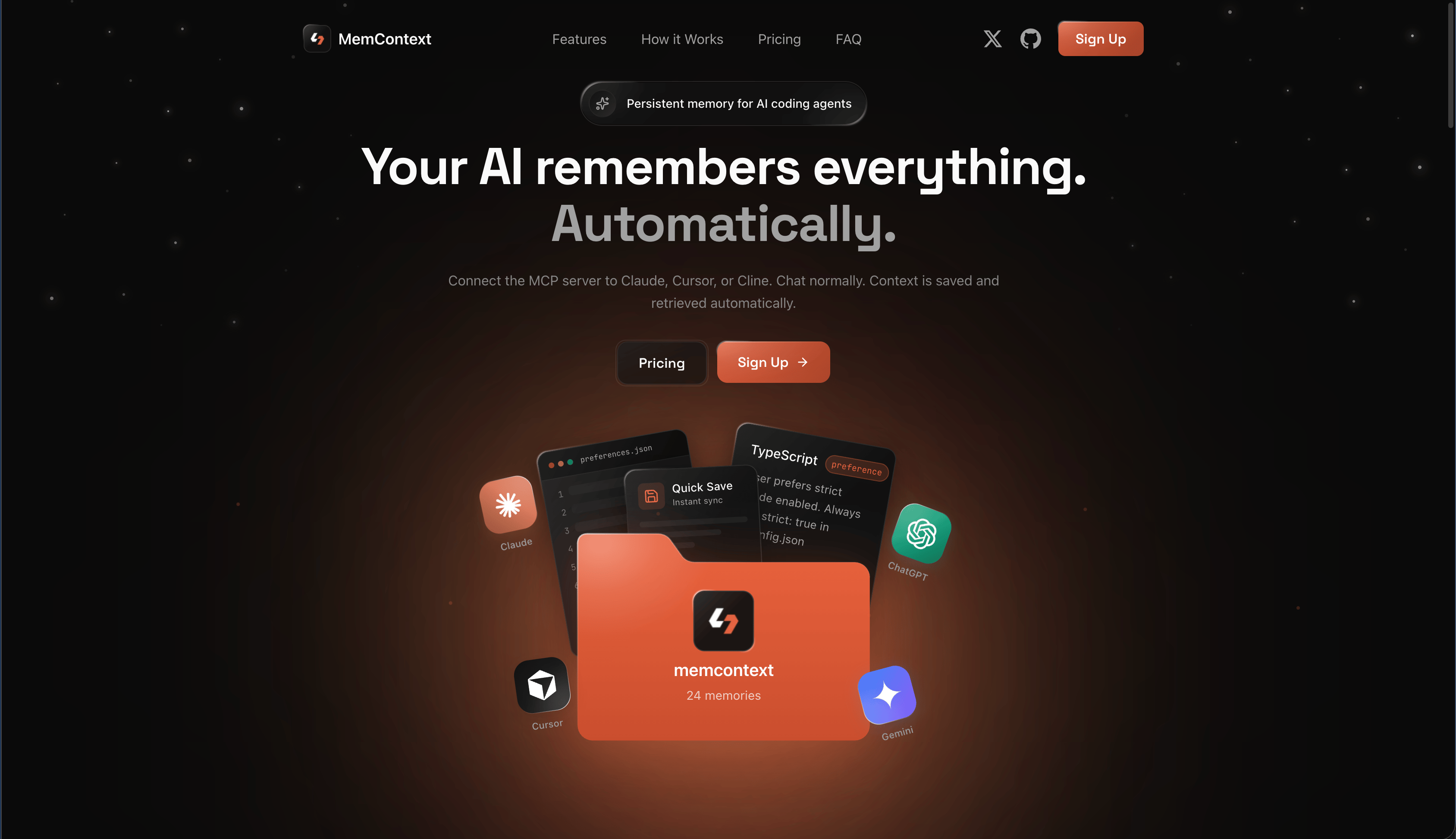
MemContext solves one of the biggest gaps in AI-assisted development: agents lose user preferences, project context, and prior decisions between sessions. I built it as a persistent memory layer that plugs into MCP-compatible tools so assistants can save, retrieve, and evolve context instead of starting from zero every time. The hosted product is designed to be simple to adopt, connect an API key, add the MCP config, and your assistant starts remembering across sessions.
It is used by enterprises and companies in production — not just as a coding-agent plugin. One company built their AI support on MemContext; that system now handles 80% of their support tickets, powered by the same memory layer.
The system combines a Hono API, MCP server, Next.js dashboard, public docs, and marketing site inside a Turborepo monorepo. Under the hood it uses hybrid retrieval with vector embeddings and PostgreSQL full-text search, relation-aware memory updates, temporal expiry, feedback-aware ranking, and project-scoped organization. That makes the memory layer useful not only for one agent, but across Claude, Cursor, OpenCode, Codex CLI, Windsurf, custom apps via REST, and production support workloads.
Technical Challenges
Combining vector embeddings, PostgreSQL full-text search, and query-variant retrieval into a memory layer that surfaces relevant context instead of noisy matches.
Designing evolving memory flows so entries can be saved, updated, extended, expired, and ranked by feedback without creating duplicate context.
Building MCP-native integrations that work reliably across multiple coding agents, transports, and setup styles.
Structuring a monorepo that shares types cleanly across the API, MCP server, dashboard, docs, and website while keeping deployments independent.
Tech Stack
Status
Current Status
Completed & Live
Last Update
2026